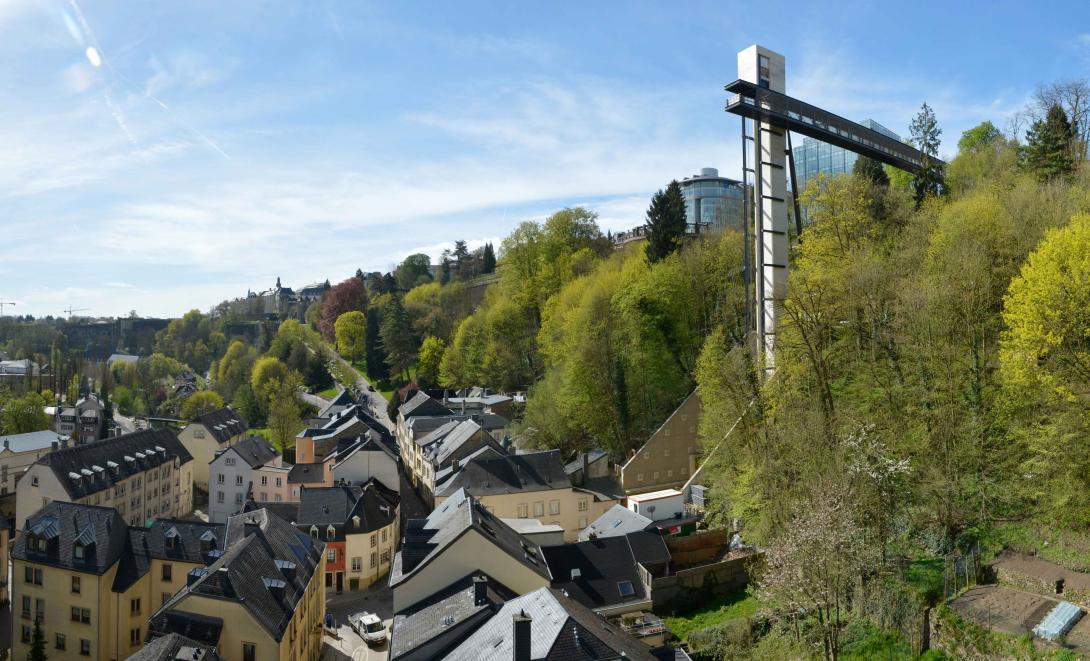
Luxembourg City's public lifts, in particular the Pfaffenthal panoramic lift, the Grund lift and the panoramic lift at the Luxembourg City History Museum, play a key role in helping people understand and explore the city's heritage. These lifts are not only transport infrastructures, but also tools for experiencing the city's history, architecture and evolution.
The city of Luxembourg is characterised by the stark differences in elevation between the upper town and the river valleys. The Pfaffenthal panoramic lift connects the Ville Haute with the Pfaffenthal district, offering panoramic views of the Alzette river valley and the surrounding historic areas. This visual experience helps visitors understand how the city developed around its natural topography and fortifications, many of which are part of UNESCO's world heritage.
The Grund lift connects the upper town with the Grund district, one of the oldest parts of Luxembourg City. By facilitating access to this lower historic district, the lift makes it easier for visitors to explore its medieval streets, river slopes and traditional urban fabric. The journey itself, including the pedestrian tunnel with artistic elements, contributes to a cultural and interpretative experience rather than a purely functional one.
The panoramic lift inside the Luxembourg City History Museum has a more explicitly interpretative role. As visitors move vertically through the museum, the glass lift reveals rock foundations, architectural layers, and views of the surrounding historic landscape. This vertical movement symbolically mirrors the passage through time, helping visitors understand the geological and historical layers on which the city was built.
Together, these lifts enhance accessibility, provide unique viewpoints, and connect different historic quarters that in the past were difficult to reach. By combining modern engineering with heritage settings, they transform everyday movement into a meaningful way of discovering Luxembourg City’s history, geography, and urban identity.