Pedrinhas - Cooperativa de Solidariedade Social e Cultural - Pedro Brasiao Rodrigues, CRL
Summary
Description
Implemented in partnership with a Portuguese municipality and a the social and cultural
cooperative Pedrinhas, the project combines accessible materials, Universal Design for
Learning principles, and participatory methodologies to ensure meaningful inclusion in cultural activities.
The project directly addresses recognised gaps in access, participation and literacy
development among children with CCN by creating inclusive, accessible storytelling
environments. It aligns with national and international policy frameworks on disability rights
and inclusion, responding to the need for culturally relevant, community-based interventions
that remove communication, sensory and environmental barriers.
In terms of development, Historias Inclusivas adopted an action-research approach,
integrating design, implementation and evaluation in a cyclical and collaborative process.
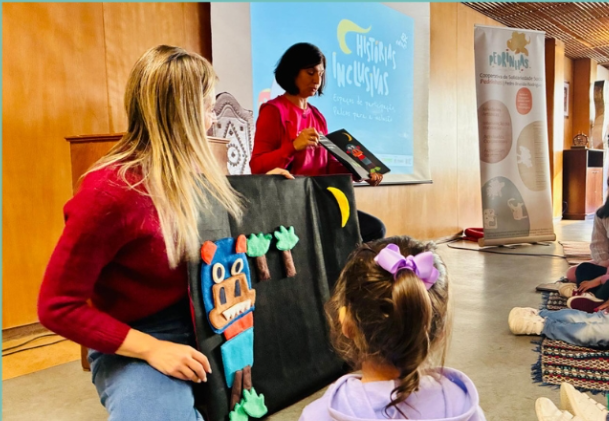
The project has already been implemented in 3 Portuguese municipalities, until 2025, and will be implemented in a fourth munitipality in the second half of 2026. In the more recent editions (2024 and 2025), six storytelling sessions were delivered in an accessible municipal library setting, incorporating adapted and multisensory stories supported by pictographic symbols, assistive technologies, tactile materials and 3D-printed resources. The sessions were
facilitated by an experienced storyteller, supported by the research team, and complemented by a professional training initiative aimed at building local capacity in inclusive literacy
practices.
An evaluation process involving different stakeholders has been implemented in 2024/2025.
The project outputs included: (i) the development of accessible storytelling materials and
equipment for six adapted narratives; (ii) the implementation of a structured programme of
inclusive cultural sessions reaching approximately 70 children and family members; and (iii)
the delivery of a certified short training course for education and community professionals.
These outputs collectively enhanced both immediate access to inclusive literacy experiences and longer-term sustainability through knowledge transfer and skills development.
Evaluation findings demonstrated strong outcomes. Children reported high levels of enjoyment, active participation and emotional engagement, with 96.8% feeling highly involved and 100% describing the sessions as very enjoyable. Caregivers highlighted the quality of materials, the multisensory approach and the inclusive interaction as key strengths, while the storyteller's assessments confirmed high levels of engagement and receptivity.
The project shows significant potential for scalability and replication. Its structured
methodology, use of adaptable resources and reliance on cross-sector partnerships provide
a transferable model for inclusive cultural programming in other communities. Future
development may focus on expanding reach, refining spatial and organisational aspects of
delivery, and deepening professional training to further strengthen systemic inclusion in early
literacy.
The project adopts an action-research framework, characterised by cyclical phases of
planning, implementation, observation and reflection. This approach enabled the team to respond dynamically to emerging needs while integrating theory and practice in a
collaborative manner.
The storytelling sessions are designed and delivered in public municipal libraries, with
physical access, each lasting 45-60 minutes. Sessions combine adapted storytelling and
multisensory approaches, informed by methodologies such as Adapted Stories and
BagBooks multisensory storytelling, and guided by the principles of Universal Design for
Learning (UDL).
Stories are carefully cocreated or selected and transformed into accessible formats using:
- Pictographic symbols and visual supports for communication accessibility;
- Tactile, auditory and olfactory stimuli to support multisensory engagement;
- Assistive technologies and 3D-printed materials to facilitate interaction;
- Participatory activities, including manipulation of objects and related creative tasks (e.g.,
painting).
Sessions were delivered by an experienced storyteller with expertise in inclusion, supported
by the project's team, ensuring both professional quality and methodological consistency.
The users’ input has been embedded throughout the project:
- Needs identification (ex ante): The project was designed in response to recognised barriers
faced by children with CON in accessing literacy and cultural activities, ensuring relevance
and inclusivity from the outset;
- User-centred design: Materials and activities were developed to accommodate diverse
sensory, cognitive and communication profiles, enabling participation without reliance on a
single mode of interaction;
- Direct feedback from children: Children’s perceptions were collected in structured
interviews using accessible formats (easy-to-read language and visual supports). Their
feedback informed strengths (e.g., enjoyment of sensory interaction) and areas for
improvement (e.g., interest in puppets or new themes), [designforall.org]
- Caregiver and professional input: Online questionnaires gathered caregivers’ perspectives
on relevance, engagement and accessibility, as well as suggestions (e.g., spatial
organisation, additional activities, inclusion of music). The storyteller’s evaluations
complemented these insights with professional observations.
- Iterative refinement: Findings from each phase were used to adjust subsequent sessions
and inform future developments, reinforcing responsiveness to user needs.
The evaluation conducted during the 2024 edition of the project demonstrates high
effectiveness, strong user satisfaction and meaningful social impact, evidencing the project’s
success as an inclusive cultural intervention.
- Interviews with children (n=31):
100% reported high enjoyment; 96.8% indicated active participation; 96.8% reported positive
emotional outcomes; and 77.4% experienced strong narrative engagement/transportation,
reflecting both cognitive and affective impact.
- Survey to caregivers (n=26):
96.2% confirmed that the sessions fully met the children’s needs, and 88.5% reported that
their own expectations were fully met, highlighting perceived relevance, quality and
inclusiveness.
- Professional (storyteller) evaluation:
The storytelling sessions achieved a mean score of 4.75/5 in both participation and overall
quality, confirming a consistently high standard of delivery and engagement.
Beyond these quantitative outcomes, the project demonstrates broader structural and societal impact. It has been co-funded by the Portuguese Institute for the Rights of Persons with
Disability (IDiPD, I.P.), reinforcing its alignment with national inclusion policies and priorities.
Furthermore, the project has already been presented and published as a good practice in an
international conference on Inclusive Education, supporting its recognition, transferability and potential for wider dissemination.
Historias Inclusivas is innovative in that it transforms traditional storytelling — typically reliant on verbal and visual modes — into an accessible, multisensory and participatory cultural
experience, thereby removing key barriers to access, understanding and engagement for
children with diverse abilities, including Complex Communication Needs (CCN).
The project improves the current situation by shifting from standard, non-inclusive literacy
practices to a Design for All model, where a single cultural service is proactively designed to
be usable, meaningful and engaging for all children. This is achieved through the integration
of multisensory storytelling, augmentative communication supports and active participation
strategies, significantly enhancing access, inclusion and quality of experience compared to
conventional approaches.
This innovation is directly aligned with the ENIPD 2021-2025 (National Strategy for the
Inclusion of Persons with Disabilities in Portugal), which prioritises the removal of barriers and the promotion of accessible cultural and educational environments. By operationalising these principles in a community-based cultural programme, the project contributes concretely to national policy goals on inclusion and equal participation.
It also reflects the principles of the United Nations Convention on the Rights of Persons with
Disabilities (UN CRPD), particularly the rights to access culture, information and participation
(Articles 9 and 30), by ensuring that children with disabilities can engage in cultural life on an
equal basis with others.
At the national level, the project is consistent with inclusive education and accessibility
legislation in Portugal, which promotes universal access, differentiated pedagogy and
inclusive participation in community and educational contexts. By extending these principles
beyond formal education into cultural services, Historias Inclusivas represents a novel and
transferable model that bridges policy and practice.