Eyes Japan - non-incorporated public-interest project operated by Lingyu Zhang
Summary
Description
Eyes Japan is a free multilingual visual-accessibility information infrastructure for blind and low-vision people, companions, and foreign visitors in Japan. It is operated in Osaka by Lingyu Zhang, a low-vision retinitis pigmentosa person and IT/network engineer with nearly 20 years of web, server and community-platform experience. Since 2009 he has supported retinitis pigmentosa patient communities online; Eyes Japan applies that long-term disability-community technology work to Japan's public, cultural and tourism information environment.
The project addresses a barrier that often appears before a journey begins: a blind or low-vision person may not know whether a facility entrance, route, tactile paving, assistance counter, toilet, guide-dog policy, elevator, audio guidance, staff support or crowd condition can be understood in advance. If this information is scattered, visual-only, available only in Japanese, or uncertain, the person may simply decide not to go.
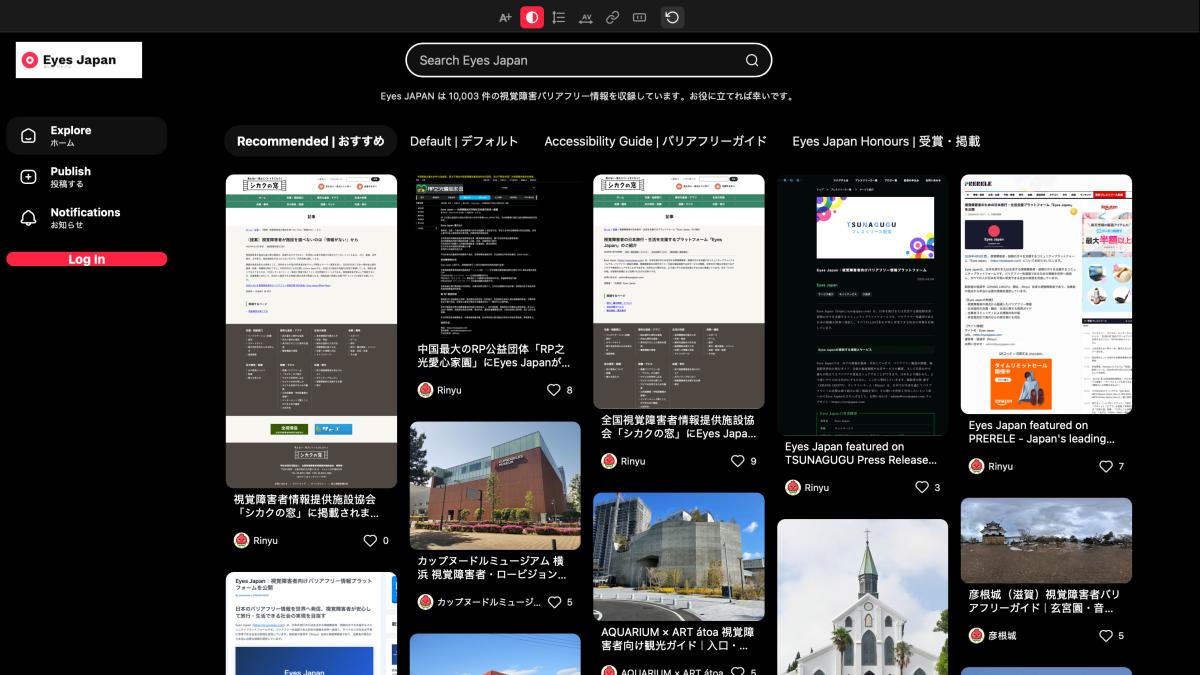
Eyes Japan publishes facility-by-facility pre-visit guides in Japanese, Chinese, English, Vietnamese and Korean. The platform is high-contrast by default, supports desktop and mobile access, includes top-bar visual assistance controls such as font size, spacing and theme switching, and does not rely on visual CAPTCHA for registration or posting. The founder has tested basic operation with VoiceOver and NVDA with good results.
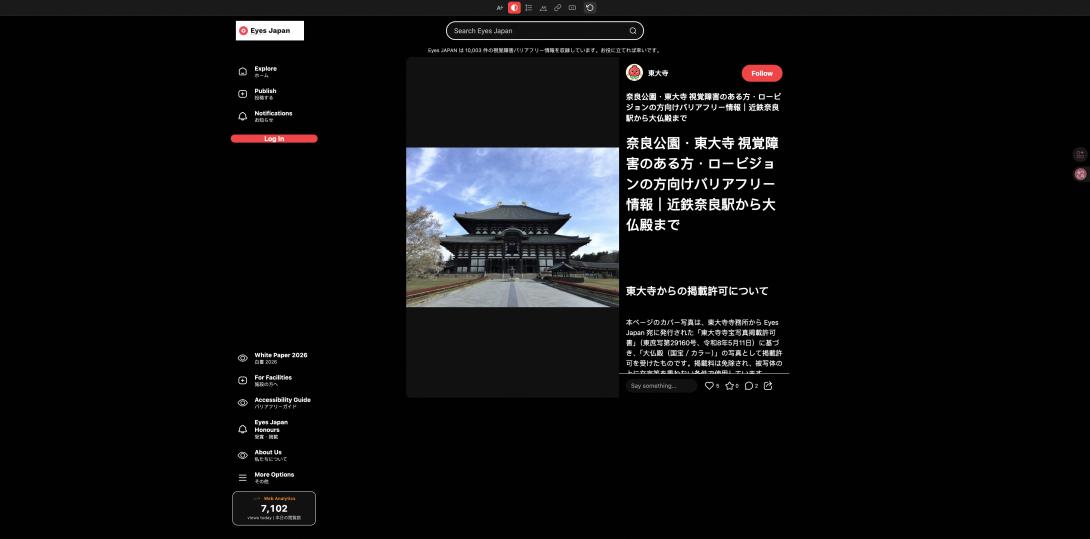
As of the 2026 public snapshot, Eyes Japan covers about 1,900 facility sets and more than 9,500 accessibility guide posts. External analytics from Cloudflare and Google Analytics have shown days with approximately 5,000 to 8,000 worldwide visits. Facility and public-institution interactions include Todaiji Temple's formal permission to publish a National Treasure Daibutsuden image, Osaka Prefectural Yayoi Culture Museum's facility-side publication, and review/correction or official-information cooperation from major museums, landmarks, gardens, aquariums, towers, hotels, and cultural facilities.
The output is not only a directory. It is a Design for All process: lived-experience design, free multilingual access, community knowledge, institutional correction, and continuous improvement. Its goal is to turn "I cannot know whether I can go" into "maybe I can go."
Objectives
Eyes Japan aims to make pre-visit accessibility information understandable, searchable and usable for blind and low-vision people in Japan, including foreign visitors and multilingual residents. It connects directly with Design for All because it treats information itself as part of the designed environment. A station, museum, temple, tower or hotel may have accessibility features, but if a person cannot understand them before leaving home, the practical service remains incomplete.
1 Reduce pre-visit information barriers for blind and low-vision people.
2 Provide free multilingual access in Japanese, Chinese, English, Vietnamese and Korean.
3 Make the interface usable for low-vision users through a high-contrast default design and adjustable visual controls.
4 Let users and facilities improve public information through community posting and facility correction workflows.
5 Support cultural, tourism and daily-life participation by helping people make their own movement decisions.