Elisava, Barcelona School of Design and Engineering (UVic-UCC); Nexe Fundació
Summary
Description
This collaborative academic initiative between Elisava Barcelona School of Design and Engineering (UVic-UCC) and the CRIT (Research, Innovation and Technology Center) at Nexe Fundació aims at designing new products responding to specific needs of children with multiple disabilities. Six groups of students from the 3rd course of the Bachelor in Design and Innovation have been paired with children aged 2-6 at Nexe during one academic semester, where they approached the context, understood each kid's reality, and developed a functional prototype to improve his or her wellbeing and development.
The objectives of the project are twofold, in relation to each organisation:
For Nexe: The project aims at developing functional, personalised and affordable accessories for children with multiple disabilities with the goal of improving their wellbeing, autonomy and inclusion.
It also raises awareness within Nexe about design and innovative solutions as tools for benefitting its specific context, workers and users.
For Elisava: The course offers students a practical immersion to human-centered design in a real-world social context to further develop their learning as future designers while addressing questions about the responsibilities and ethical values of the profession.
In the first stage of the course, students are introduced to the concept of Social Design and to Nexe’s reality through talks and readings.
Nexe also introduces the profile of six children within their organisation, with a short briefing associated to needs that the personnel at Nexe already detected. Students are organised in groups and each one choses a challenge – they are also informed that they will be able to address another challenge if it is detected during field research.
Subsequently, the field research is undertaken during 6 weeks, which enable students to empathise with the child to understand their situation and further identify their needs. During this phase, students and personnel at Nexe are constantly engaged in conversations and exchange of information, with the aim to respond to real user preferences and to take into account technical and/or physical requirements.
After 8 weeks, the groups present to Nexe and the academic team their research and analysis, together with two value proposals that respond to the childrens’ needs, from which one is chosen to develop.
The following 6 weeks students are solely dedicated to this course, and the product development phase starts, which has prototyping and testing as the main methods. Constant feedback by teachers and Nexe personnel ensures that all issues are taken into account before presenting the final product. Children with multiple disabilities in this context do not have the ability to verbally communicate with the designers, so as for “Users involvement” checklilst above, we understand the consultation as testing, and feedback as the physical responses children have when testing the prototypes.
This last phase of the project also includes the development of a photobook and a video designed with the family in mind, and in most cases with their collaboration. This is aimed at presenting the childs’ characteristics, personality, problematics from a visual/poetic perspective that complements the product design.
The last day of the course, a public presentation was held. It was an emotive moment in which students, educators and families gathered to share the projects and their thoughts on the process and the results.
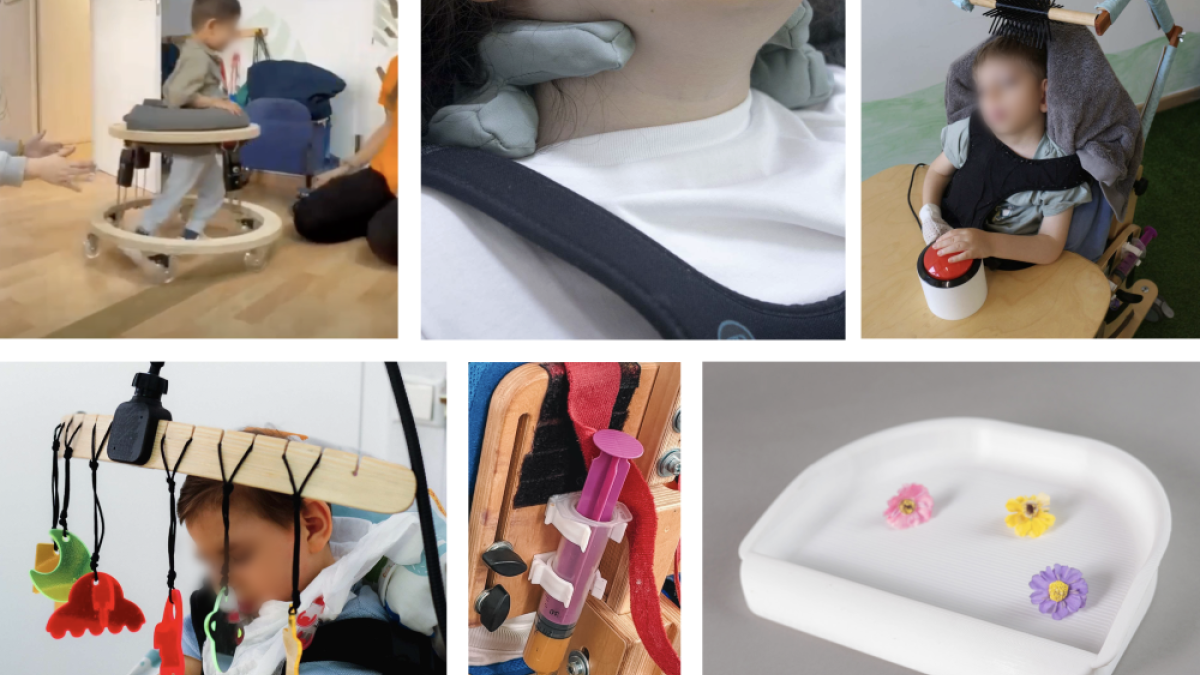
The main outputs are the 6 projects the students developed during the semester, a range of products that addresses the needs of specific children with multiple disabilities, offering personalised solutions, while at the same time providing alternative products to those in the market, which does not address their specific characteristics nor fulfill their specific needs.
— A walker for Nore. By Joana Altava, Max Reboreda, Maria Ruedas, Kaya Siercks.
— Acércate. Sensorial stimulation elements for Toni. By Paula Galli, Orlando Lara, Nil Perez.
— Asteroide B612. Massager with push button for Marc’s emotional autoregulation. By Adriana Coca, Mariona Font, Irene Muñoz, Maria Subirà.
— Coi. Head control support for Mage. By Matteo Co, María Gómez, Rut Manero, Helena Pastrana.
— Sensory exploration trays for Bruno and Josue, and support for gastric tube syringes. By Jessica Caiza, Carla Fernandez, Sònia Herreros, Romina Pereyra.
— Support system for WC adapter, to improve Abi’’s bowel and bladder control. By Inua Estruga, Carla Lozano, Aitana Masip, Alice Romano.
Each group also designed a photobook as a gift for the family and a video as a poetic communication piece.
Additionally, each student presented a proposal for improving one of Nexes’ spaces: kitchen, playground, corridor, educators’ room, meeting and lunch room, multisensory room.
The novelty considerations can be addressed in different perspectives:
First, within the educational context, this collaboration is relevant as it includes as partner a social entity dedicated persons with special needs. It offers a context in which young design students can immerse themselves in an environment that allow them to improve their soft skills and incorporate relevant social values into their professional approach.
Second, the project provides children with special needs personalised solutions that cannot be found in the market, presented as open design solutions which can be used by or adapted to other children with similar situations. Special emphasis has been put into directing students to use repurposed materials or manufacturing methods that can be easily reproduced, in order to facilitate the products’ adoption in other contexts.